CE Approved Mini Excavators: The Guide to Compliance
CE Approved Mini Excavators: The Guide to Compliance
Blog Article
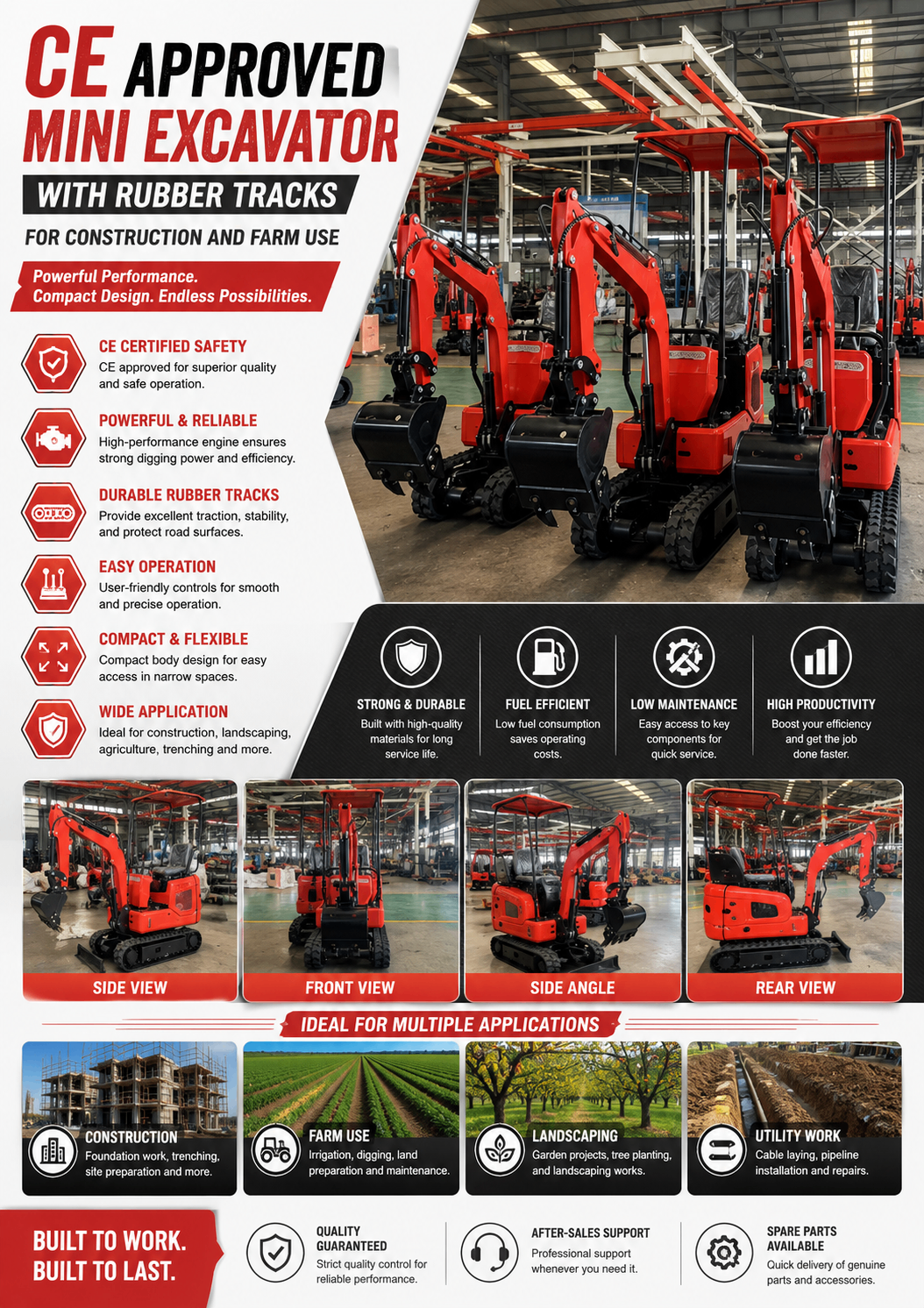
Ensuring your compact digger meets European certification requirements is vital for market within Europe. This guide details the important aspects of EU approval for small diggers, covering directives related to safety, equipment assessment, and documentation. Knowing the specifications enables companies to safely use their machinery and circumvent potential penalties.
Specialized Track Mini Excavators: Superior Traction for Tough Landscape
Mini machines equipped with rubber tracks are transforming how contractors work with projects in demanding conditions. Unlike traditional tire-equipped models, these flexible machines deliver remarkable traction on loose surfaces like sand, snow, and steep slopes. This enhanced balance allows operators to execute work effectively and productively, lessening downtime and optimizing output. The compliant nature of composite tracks also lessens ground compaction, preserving delicate surfaces and lessening environmental damage.
Compact Machines: Significant Output in Confined Construction Areas
These powerful miniature excavators provide a notable approach for tasks where large equipment easily work. Their reduced footprint allows access to challenging areas, such underground utilities or between established buildings. Despite their size, they possess considerable excavating ability and precision, allowing them ideal for a wide range of demolition applications. Ultimately, small excavators symbolize a intelligent tool for builders facing the challenges of confined areas.
Compact Machines for Properties: Versatility and Effectiveness in Agricultural Jobs
Modern agriculture operations often require tools that can handle a wide range of demanding jobs. Small machines are quickly becoming invaluable assets for growers , offering exceptional flexibility and performance across a diverse array of agricultural tasks . From trenching for irrigation networks and drainage to relocating earth for constructing enclosures or platforms, these Small construction excavator machines provide a capable solution. They also excel at removing land for seeding , leveling fields , and processing materials with ease . Their small size allows them to function in restricted locations that larger vehicles simply cannot navigate.
- Excavating for Irrigation
- Shifting Soil
- Removing Land for Planting
Determining the Best Mini Machine regarding Building vs. Agricultural Uses
When considering a mini excavator , it's vital to understand the crucial variations between site projects and rural tasks . Construction sites often necessitate increased power , exactness, and the capacity to work in tight spaces . Consequently , a heavy-duty model with a extensive assortment of attachments might be preferable. On the other hand, agricultural land frequently involve reduced digging amounts, frequent landscape grading , and the requirement for compact equipment to move through open areas. Finally , thorough assessment of the anticipated workload is paramount for making the suitable selection .
- Evaluate trenching requirements.
- Determine the area constraints .
- Evaluate the required implements.
- Factor in transportation difficulties .
{CE Marking & Mini Compact Equipment: What You Require to Be Aware Of
Ensuring your {mini compact machine is meets the requirements of relevant European directives is crucial, and that's where {CE marking comes into play . This identification demonstrates that the device has been assessed and meets safety requirements, allowing unrestricted sale within the European Economic Area . {For owners of these machines, understanding CE certification is essential . It isn't simply about having a label on the machine ; it represents a evaluation of construction and operation .
- Ensure the visibility of the CE label .
- Examine the DoC – this details the guidelines the excavator meets.
- Consider that CE marking is the manufacturer’s responsibility – even owners must be aware of its significance.